About our school
Grangemouth High School serves the town of Grangemouth in east central Scotland. Grangemouth is a town which is justly proud of its industrial heritage; it is a major port and is the centre of Scotland’s petro-chemical industry.
Grangemouth High School is a non-denominational six-year comprehensive school with a roll of around 810. The majority of pupils come from the three primary schools in the town, with some placing requests from other areas. Over 75% of S4 pupils stay on for S5, and around 60% of them stay on for S6. The school has full provision for pupils with additional support needs, including integrated provision for pupils with communication difficulties, and has been built with appropriate facilities for disabled people.
Pupils at Grangemouth High School benefit from a very positive ethos and a supportive and caring environment, where all pupils are encouraged to do their best, both in terms of formal attainment and in areas of wider achievement.
The school plays an important role in a vibrant community and has an active Parent Council and support group. Parents are welcome in the school at all times and are encouraged to share in the life of the school. The school has strong links with local industry and commerce and is often involved in partnership projects within the community.
History of Grangemouth High School
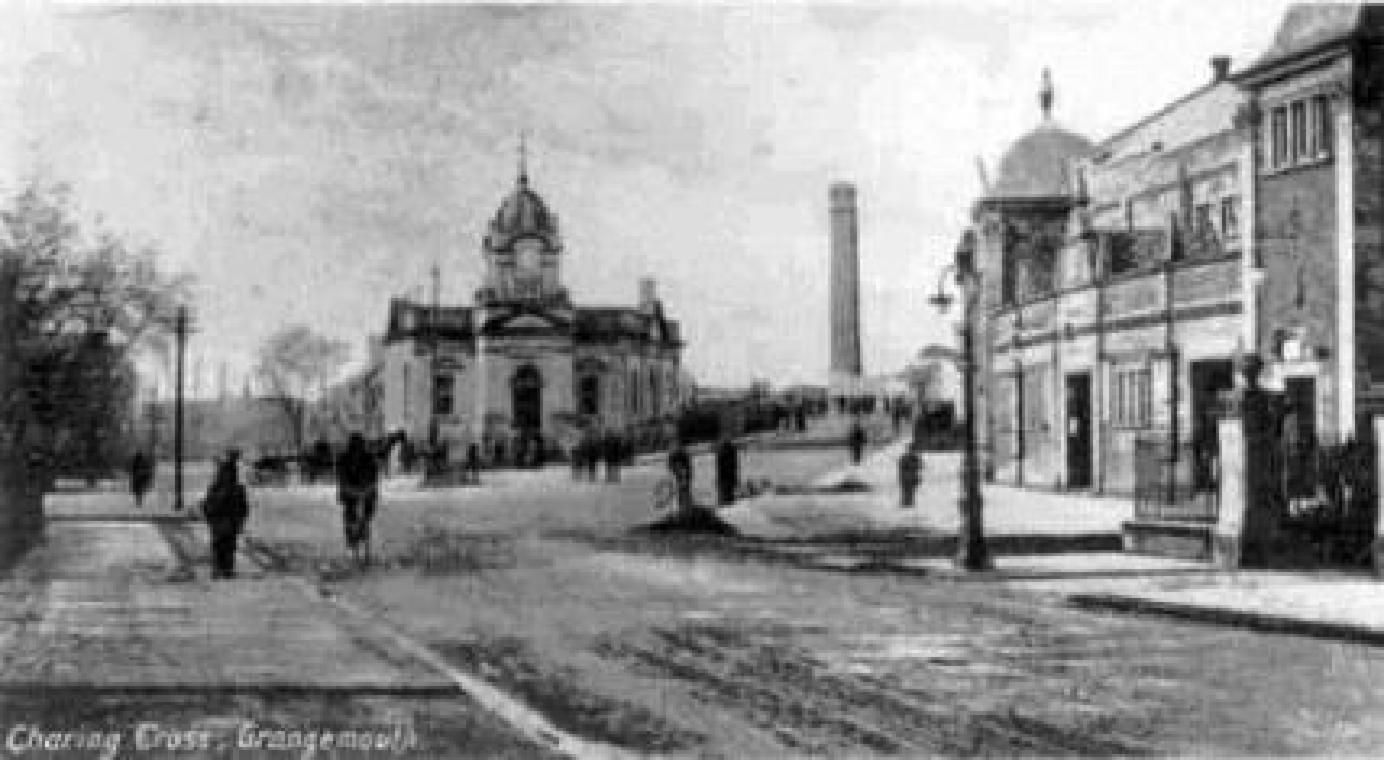
The Town of Grangemouth has had a distinctive High School since 1909 when the purpose-built new school was formally opened by Professor Andrew Gray of Glasgow University.
Originally pupils who passed the ‘qualifying examination’ went to the high school for three years of secondary education before completing their final two years at Falkirk High School.
Both the sciences and the arts have featured strongly in the school's history and as the town developed as the hub of the petro-chemical industry of Scotland the sciences have proved a popular route to local employment.

The Performing Arts also have a long and well merited standing in the local community ; in the 1930s eight pupils sang in a Royal Command Performance at the Albert Hall in the presence of the King and Queen. The Art master from the 1920s to 1951 was the famous James W Davy whose son Alan Davy is now an internationally acclaimed artist, and Jock Leydon, who emigrated to South Africa where he became an internationally renowned cartoonist with the Rand Daily Mail, is a former pupil. Some of Jock Leydon’s work now hangs proudly in the school.
Other famous ex pupils include the footballer George Young, Sir David Tweedy (the current chairman of the International Accounting Standards Board), broadcaster Kaye Adams, and commonwealth gold medallist Steve Frew.
Over the last decade around three dozen senior pupils each year have progressed successfully to universities across the land to continue their advanced study in Law, Dentistry, Medicine, Business and Commerce and a wide range of Sciences and the Arts.
The school’s long tradition in music and drama has continued unabated and in 2005 the BBC Sound Town Project hosted the school production of Juliet’s Tomb at the Edinburgh Festival.